AI product manager
I Built a Multi-Agent AI Product. Here Is What Actually Changes for Product Managers
A practical comparison of traditional and AI product management across requirements, evaluation, data, economics, and human oversight.
Quick take
An AI Product Manager is still a Product Manager: understand users, choose valuable problems, align teams, and deliver measurable outcomes.
What changes is the product’s behaviour. Traditional software follows specified rules; AI outputs can vary with context, data, and model behaviour.
The AI PM therefore manages not only features, but system behaviour under uncertainty.
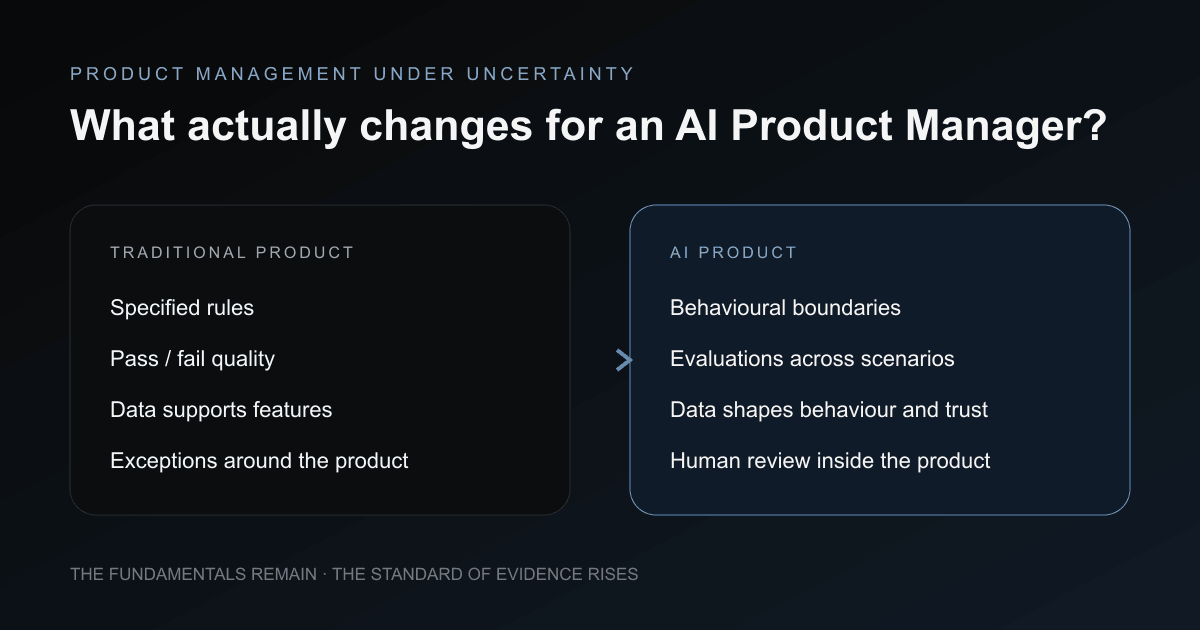
Traditional PM vs. AI Product Manager
| Responsibility | Traditional product | AI product |
|---|---|---|
| Requirements | Functional rules and acceptance criteria | Expected behaviours, boundaries, and fallback paths |
| Quality | Mostly pass/fail testing | Evaluations across representative and changing scenarios |
| Data | Supports features and reporting | Directly shapes product behaviour and trust |
| Economics | Infrastructure and development costs | Cost, quality, and latency per interaction |
| Operations | Exceptions handled around the product | Human review designed into the product |
1. Requirements become behavioural specifications
A conventional requirement might say: “When the user submits a valid form, create a ticket.”
For an AI workflow, “working” is rarely binary. The PM must define:
- Representative normal and edge cases.
- Acceptable and unacceptable outputs.
- Evidence shown to the user.
- When the system should ask, stop, or escalate.
- Actions it must never perform.
The requirement describes behaviour under uncertainty, not just functionality.
2. Evaluation becomes product design
While developing a multi-agent operations prototype, I defined metrics for task success, escalation precision, latency, cost per interaction, hallucination checks, and human review.
These metrics helped determine what the product was allowed to do.
Evaluation should combine representative cases, task performance, expert review, production monitoring, and business outcomes.
3. Data becomes part of the user experience
Users experience data quality directly through AI.
An assistant may give an outdated answer because its source is stale. An agent may recommend the wrong action because records are inconsistent or essential context is missing.
My work on enterprise data foundations reinforced that freshness, governance, ownership, and access control determine whether users can trust the result.
4. Cost, quality, and latency become strategic trade-offs
The most capable model is not automatically the best product choice.
A larger model may improve quality but increase cost and latency. More context or agent steps may improve results while making the system more expensive and harder to observe.
The PM decides where advanced AI creates value, where a smaller model is sufficient, and where deterministic software is better.
5. Human review becomes an operating model
“A human will review it” is not a complete strategy.
Someone must inspect the evidence, decide, and record a correction. Permissions, workload, escalation, and auditability must be designed.
If reviewers have to repeat the entire analysis, the AI may have moved work rather than removed it.
Does an AI PM need to code?
No—but hands-on prototyping helps.
Prototyping taught me where retrieval fails, how memory changes behaviour, why observability matters, and how complexity affects latency and cost.
The goal is not to replace engineering. It is to test product assumptions before converting them into expensive roadmap commitments.
AI Product Management is not a completely new profession. It is product management applied to less predictable, more data-dependent systems. The fundamentals remain; the required standard of evaluation and operational responsibility rises.