AI product discovery
How I Use AI in Product Discovery (Without Outsourcing Product Thinking)
A five-step AI product discovery framework that combines faster analysis with human judgment and traceable evidence.
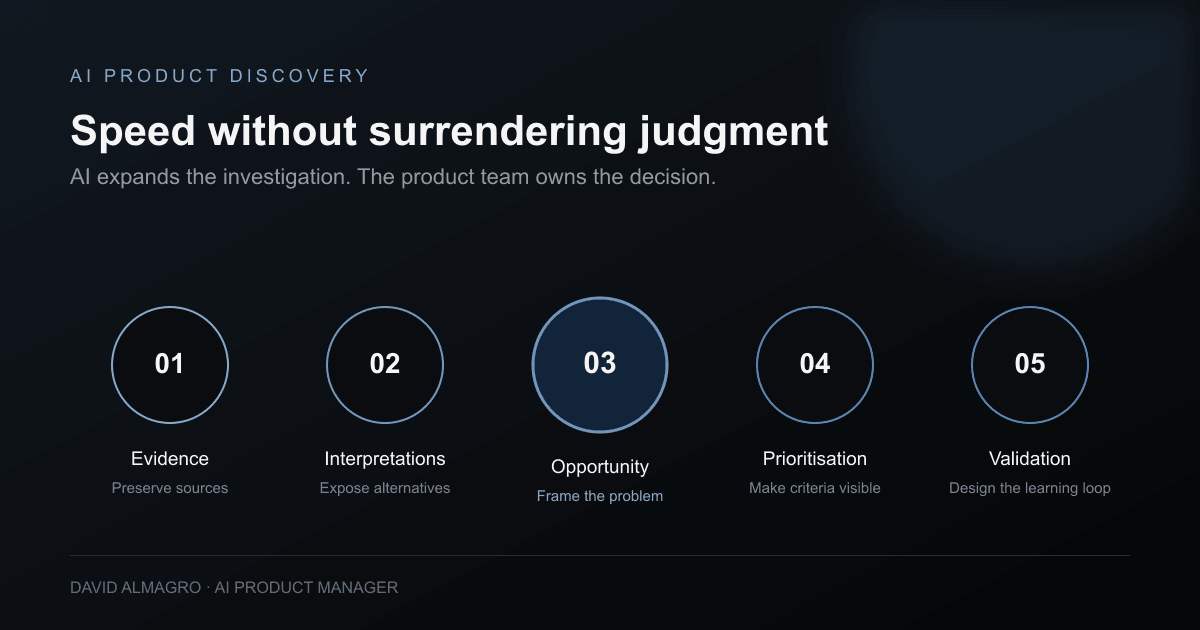
Quick take: my AI product discovery framework
AI can accelerate product discovery, but it should not own product decisions. My five-step framework is:
Evidence → Interpretations → Opportunity → Prioritisation → Validation
AI provides speed and breadth. The product team keeps strategic context, judgment, and accountability.
Why instant synthesis creates weak roadmaps
The tempting workflow is to upload research notes, ask an LLM for the main problems, request features, and turn the result into a roadmap.
It may look convincing, but important context disappears:
- Which statements came directly from users?
- Which are AI-generated interpretations?
- What evidence contradicts the recommendation?
- Who owns the business decision?
LLMs create coherent stories from incomplete information. In discovery, coherence can hide uncertainty.
The five-step AI product discovery framework
1. Preserve source evidence
Keep interviews, Jira tickets, analytics, and stakeholder requests close to their original form.
AI can help structure and search this material. Retrieval-Augmented Generation can connect responses to relevant sources, but traceability still needs to be designed and verified. The objective is not merely to “chat with data”; it is to connect insights to real user evidence.
2. Generate competing interpretations
Do not ask AI for “the answer.” Ask it to expose alternatives and edge cases:
- “Cluster this evidence by user friction, then by workflow stage.”
- “Separate observed facts from inferred causes.”
- “Find evidence that contradicts the dominant pattern.”
The team decides which interpretation deserves validation.
3. Frame the product opportunity
“Use AI to automate operations” is a technology direction, not an opportunity.
A stronger frame is:
Operations specialists spend significant time reconstructing context before escalating a case. We believe AI can assist this workflow, but we must identify which decisions require expert review.
This captures the user, friction, hypothesis, and uncertainty without inventing metrics or prematurely selecting a solution.
4. Make prioritisation criteria visible
AI can rank inputs, but it cannot decide what the business should value.
I compare opportunities using user impact, strategic alignment, engineering feasibility, evidence, data readiness, compliance risk, cost of delay, and time to learning.
In my data and AI work, attractive ideas have often depended on unreliable data, unclear evaluation, or teams unable to adopt the change safely. Those constraints belong in discovery—not after the prototype.
5. Design a continuous learning loop
Every opportunity should define:
- The first assumption to test.
- The cheapest credible test.
- The evidence that would disprove the hypothesis.
- One success metric and one guardrail.
The roadmap becomes a sequence of learning investments, not feature promises.
The human-only product stack
AI can search documents, identify themes, draft questions, and suggest experiments. I use the saved time to speak with users and align stakeholders.
I do not delegate:
- Problem framing: Why are we doing this?
- Evidence assessment: Is this signal or noise?
- Strategic trade-offs: What are we giving up?
- Risk ownership: What happens if we are wrong?
- Changing direction: When should we pivot?
AI can support the analysis. The Product Manager still owns the decision and its consequences. The opportunity is not automated product management; it is faster learning without abandoning judgment.