outcome based roadmap
From Feature Roadmap to Outcome Roadmap: A Practical Framework
How to shift from output to value with an outcome-based roadmap framework connecting strategy, product prioritization, and metrics.
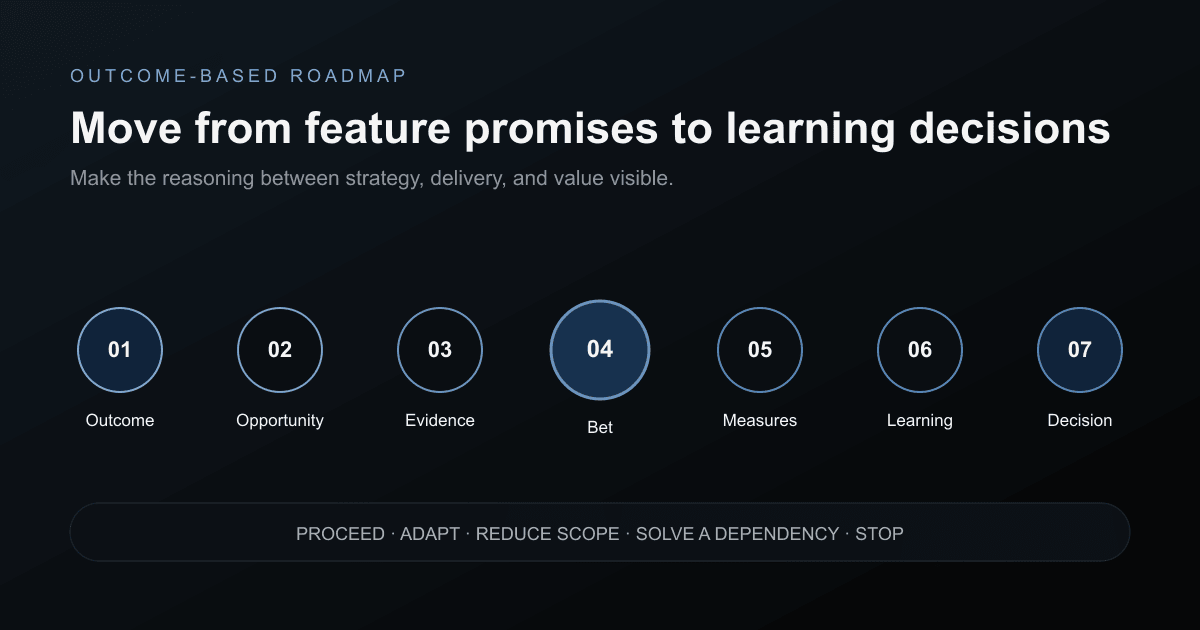
Most product roadmaps eventually become feature release schedules.
It becomes a delivery contract: useful for tracking activity, but weak at connecting decisions to customer and business value.
An effective outcome-based roadmap should answer six questions:
- Outcome: What measurable change are we trying to create?
- Opportunity: Which user or business problem could influence it?
- Evidence: What supports that belief, and what remains uncertain?
- Bet: What intervention are we choosing to test?
- Measures: How will we monitor progress and unintended consequences?
- Decision: What will we do with what we learn?
Feature roadmap vs. outcome roadmap
A feature roadmap promises outputs such as a dashboard or AI assistant, but not which problem they solve or what happens if they create no value.
An outcome roadmap might say:
- Outcome: Reduce the time required to prepare operational cases.
- Evidence: Specialists reconstruct context from several sources before acting.
- Bet: Test an assisted triage workflow that collects relevant evidence.
- Success: Reduce preparation time without lowering escalation quality.
- Guardrail: Keep high-risk decisions under expert control.
- Learning: Validate one case type before expanding the workflow.
This approach still produces features, but keeps them subordinate to the intended result.
The outcome-based roadmap framework
1. Define the outcome
Start with a measurable change in user behaviour, business performance, operations, risk, or organisational capability.
“Launch an AI assistant” is an output. “Reduce the time required to resolve a customer case” is an outcome.
2. Map the opportunity
Describe an observed problem without committing to a solution:
Product teams depend on manual, specialist-led data exchanges, creating delays, duplicated work, and inconsistent definitions.
This keeps the solution open. In public healthcare, I used Story Mapping and Impact Mapping to define three roadmaps within an operating model spanning more than ten teams.
3. Surface the evidence
Every roadmap contains assumptions. Make them visible.
Document evidence, constraints, and contradictory signals. Separate what the team knows from what it believes. The discussion becomes “which assumption is weakest?”
4. Place the bet
A bet is the intervention we believe could influence the outcome. The term communicates commitment without implying certainty.
A useful bet identifies the user, intended change, boundaries, and required learning.
5. Establish the measures
Use three complementary types:
- Outcome measures: The change that justifies the investment.
- Leading indicators: Early evidence that the intervention may be working.
- Guardrails: Signals of unintended harm, such as errors, excessive workload, or unacceptable cost.
In one product environment, a broader combination of prioritisation, problem decomposition, and operating-model changes contributed to an approximately 80–85% improvement in lead time. The result came from treating workflow, ownership, constraints, and delivery as one system—not from a roadmap format alone.
6. Set the decision checkpoint
At an agreed checkpoint, the team should decide whether to proceed, adapt, reduce scope, solve a dependency first, or stop.
Without decision points, teams often continue simply because delivery has begun. Learning should change the roadmap, not merely confirm it.
The one-page template
For every initiative, map:
Outcome → Opportunity → Evidence → Bet → Measures → Learning → Decision
Features explain what the team plans to build. Outcomes explain why it matters. Evidence supports or challenges the logic. Decision points make strategy adaptable without pretending uncertainty has disappeared.